Airway-focused orthodontics is an approach to straightening teeth and aligning the bite that also considers how jaw size, palate shape, and tongue space affect breathing. Traditional orthodontics focuses mainly on tooth position and bite. An airway-focused approach evaluates the same things alongside breathing pattern and sleep, then builds an individualized treatment plan. It can be part of a coordinated plan with medical providers, but it doesn’t replace a medical diagnosis or treatment for sleep apnea.
This article is for general education and isn’t a substitute for an in-person evaluation.
Airway-Focused Orthodontics vs. Traditional Orthodontics
The main difference between airway-focused orthodontics and traditional orthodontics is what the evaluation includes. Both straighten teeth and correct bite problems. An airway-focused orthodontic evaluation adds questions about how a patient breathes and sleeps, because jaw size and palate width also shape the space available for the tongue and airway.
| Traditional Orthodontics | Airway-Focused Orthodontics | |
|---|---|---|
| Primary goal | Straight teeth and a healthy bite | Straight teeth and a healthy bite, planned with breathing and jaw function in mind |
| Evaluation | Teeth, bite, and facial appearance | Teeth and bite, plus breathing pattern, tongue posture, sleep history, and jaw joint (TMJ) function |
| Crowding | Often addressed by aligning teeth, sometimes with extractions | Also considers whether a narrow jaw or palate is contributing |
| Imaging | Standard dental X-rays | May add 3D imaging, such as cone beam CT, to view jaw and skeletal structure |
| Coordination | Mainly with the general dentist | May include physicians, sleep specialists, ENT specialists, and myofunctional therapists |
How Jaw Growth and Breathing Are Connected
Jaw growth and breathing influence each other, especially in childhood. The upper jaw holds the palate and forms the base of the nasal cavity, and the lower jaw supports the tongue. When either jaw develops smaller or set further back, there can be less room for the tongue and airway.
Breathing pattern can also influence growth. A 2021 systematic review and meta-analysis in BMC Oral Health compared mouth-breathing and nose-breathing children. It found mouth breathing was associated with an underdeveloped lower jaw, upper front teeth tipped forward, and narrower airway measurements. The authors also noted that the influence of mouth breathing on facial bone development is still debated, so these findings describe associations rather than proof that one causes the other.
Palate Development and Tongue Space
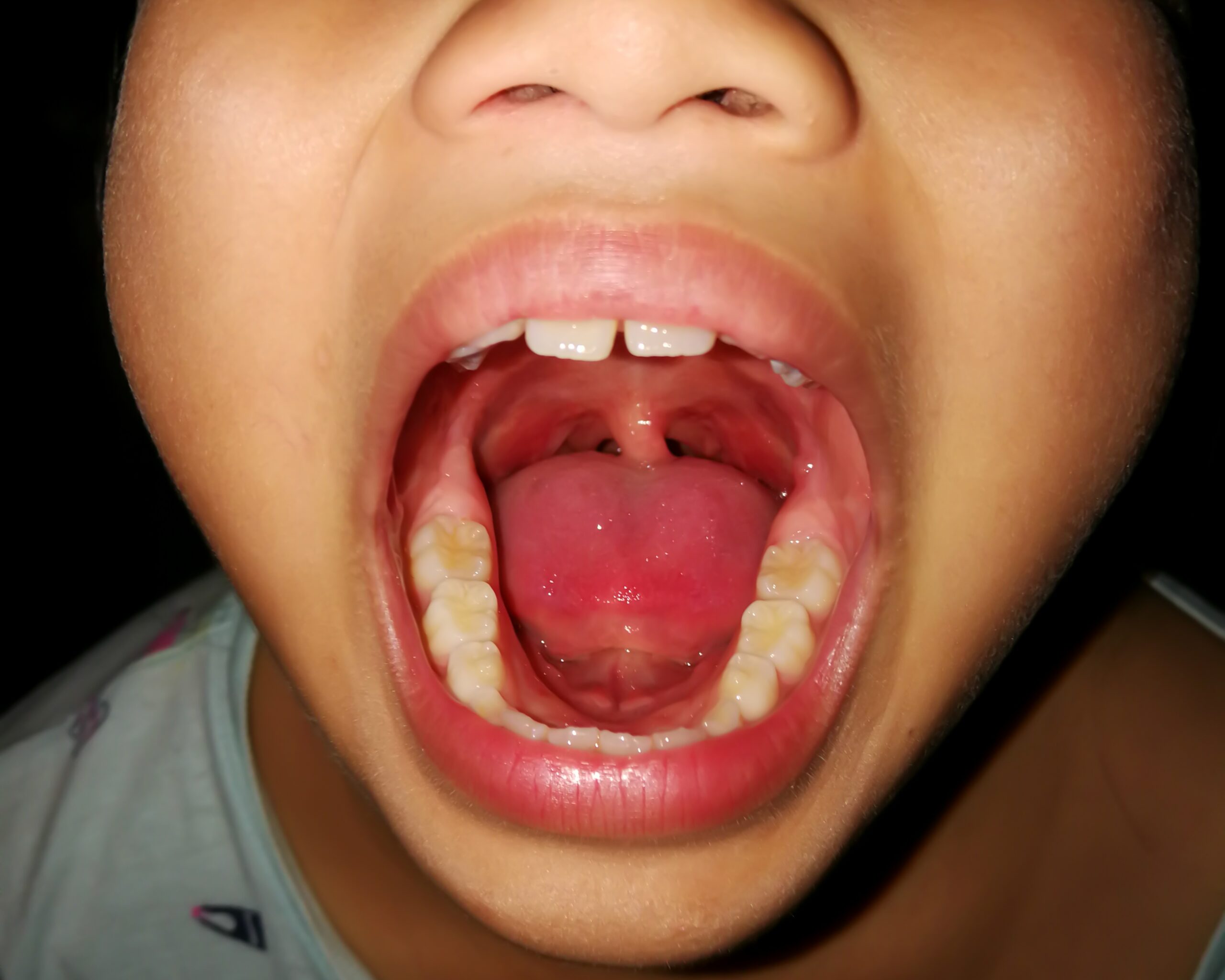
The palate, or roof of the mouth, is also the floor of the nasal cavity. A broad, flat palate leaves room for the upper teeth and for the tongue to rest against it. A narrow or high-arched palate leaves less room for both.
Tongue posture plays a role in how the palate develops. When the tongue rests against the roof of the mouth, it provides gentle pressure that supports palate width during growth. When it rests low and forward, often alongside mouth breathing or a tongue-tie, that support is missing. An airway-focused evaluation looks at palate shape and tongue space together, since crowding or a crossbite can be a sign of a width problem rather than only a tooth-position problem.
Breathing, Sleep, and What the Evidence Shows
Snoring, mouth breathing, restless sleep, teeth grinding, and daytime fatigue are common reasons patients and parents look into airway-focused orthodontics. These symptoms are worth taking seriously, and our Sleep page explains how we evaluate them.
It’s just as important to be clear about what orthodontics can and can’t do. A 2026 American Association of Orthodontists (AAO) white paper concluded that diagnosing sleep-disordered breathing should be medically led, with an overnight sleep study and clinical assessment as the standard for diagnosing obstructive sleep apnea. The paper also found no current evidence that orthodontic treatments such as palatal expansion can prevent sleep-disordered breathing.
In practice, airway-focused orthodontics treats jaw and palate problems on their own merits. When breathing or sleep concerns are part of the picture, that treatment is coordinated with a medical diagnosis and with other therapies when they’re needed.
Palatal Expansion and Growth Guidance
Palatal expansion and growth guidance are two of the main tools in airway-focused orthodontics, and the right tool depends largely on age.
| Children and Teens | Adults | |
|---|---|---|
| Growth stage | Jaws are still growing, and the seam in the center of the palate hasn’t fused | Jaw growth is complete, and the palate seam is typically fused |
| Common approaches | Palatal expanders and growth-guiding appliances that work with natural development | Orthodontics planned around airway and TMJ, sometimes with expansion techniques suited to adults |
| Typical reasons | Narrow upper jaw, crossbite, crowding from too little width | Crowding, bite problems, or TMJ symptoms alongside a narrow arch |
In growing children, an expander applies gentle pressure that widens the upper jaw itself, not just the position of the teeth. Growth-guiding appliances can also help direct how the jaws develop. Our Pediatric Care page covers how we evaluate children, and our Adult Care page explains orthodontic options for adults.
Individualized Orthodontic Treatment Planning
Individualized orthodontic treatment means the plan is built from each patient’s findings rather than a standard protocol. Two patients with similar crowding may need very different care, depending on age, jaw size, breathing pattern, and jaw joint function.
At Restorative Sleep & TMJ, Dr. Stephen Russell’s evaluation may include:
- 3D cone beam CT imaging to review jaw structure, skeletal alignment, and joint position
- Home sleep testing to see how a patient breathes at night
- TMJ and muscle assessment
- Coordination with physicians, sleep specialists, and other trusted providers as needed
Treatment is then matched to what the evaluation shows. Our Airway Care page explains these steps, and our TMJ Treatment page covers how jaw joint health factors into orthodontic planning.
Frequently Asked Questions
Can airway-focused orthodontics cure sleep apnea? No. Orthodontics can address jaw and palate problems, but sleep apnea is diagnosed medically with a sleep study and is managed with a plan coordinated with physicians. Orthodontic treatment may be one part of that plan for some patients.
Is airway-focused orthodontics only for children? No. Children benefit most from growth-guided approaches because their jaws are still developing, but adults can also have orthodontic treatment planned around breathing and TMJ health.
Does airway-focused orthodontics avoid tooth extractions? Not always. When crowding is caused by a narrow jaw, creating width may reduce the need for extractions. The right approach depends on each patient’s anatomy.
What age should a child be evaluated? There’s no single right age, but evaluating a child while the jaws are still growing gives the most options. Persistent mouth breathing, snoring, or crowding are good reasons to schedule an evaluation.
Scheduling an Airway-Focused Orthodontic Evaluation in Olympia, WA
If you or your child has crowding, a narrow jaw, mouth breathing, snoring, or jaw pain, an evaluation can show whether airway-focused orthodontics makes sense and how it fits with any other care you need. Restorative Sleep & TMJ serves patients in Olympia and the surrounding South Sound area. Schedule your consult or call (360) 915-9832.
References
- Zhao Z, Zheng L, Huang X, Li C, Liu J, Hu Y. Effects of mouth breathing on facial skeletal development in children: a systematic review and meta-analysis. BMC Oral Health, 2021. https://www.ncbi.nlm.nih.gov/pmc/articles/PMC7944632/
- American Association of Orthodontists white paper update on orthodontics and sleep-disordered breathing. American Journal of Orthodontics and Dentofacial Orthopedics, 2026. https://pubmed.ncbi.nlm.nih.gov/41770191/